
The Art of Looking
Why Some Paintings Ask Us to Slow Down
We are remarkably quick at deciding what we are looking at.
A landscape. A portrait. Figures beside a river. A train approaching through the rain. Within seconds, the subject of a painting can seem clear. But recognising what is represented is not quite the same as looking closely.
A painting may give us its subject almost immediately while revealing its visual relationships much more slowly. Where does the eye travel? Which figures connect, and which remain separate? What happens at the edges? Can a small detail change the way the whole composition is understood?
Slow looking is not simply about spending more time in front of an artwork. It is about delaying interpretation long enough to notice what is actually there.
Looking Is Not the Same as Recognising
One of the first questions we often bring to art is: What does it mean?
It is an understandable question, but it can arrive too early.
Before interpretation, there is another useful question: What am I actually seeing?
Approaches to slow looking often begin here. Instead of immediately reaching for the wall label or an explanation, attention turns first to what can be observed: colour, line, scale, texture, position, repetition, distance and the relationships between different parts of the image.
This does not make art-historical knowledge or context less important. Context can transform our understanding of an artwork. But looking first allows us to form questions before being given answers.
What Changes When We Stay?
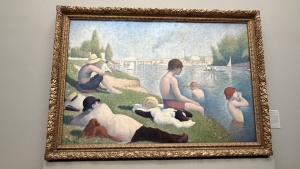
 [IMAGE: Georges Seurat, Bathers at Asnières, 1884. The National Gallery, London. Photo: Sibel Yildirim Esen.]
At first glance, Georges Seurat’s Bathers at Asnières seems easy to describe: men and boys relax beside the Seine on a hazy day.
Stay with it a little longer.
The figures share the same landscape, yet there is remarkably little interaction between them. Most seem absorbed in their own space, their poses still and almost sculptural. The riverbank leads the eye diagonally into the picture while the water opens into a broad horizontal distance.
Then the background begins to matter. Beyond the boats and the calm surface of the Seine are bridges, factory buildings and smoking chimneys. Leisure and industry occupy the same landscape.
The apparent simplicity of the scene also contrasts with the care behind its construction. Seurat developed the large painting through numerous drawings and oil studies, repeatedly working through elements of the composition.
Looking longer has not uncovered a secret meaning. Something subtler has happened: relationships between things visible from the beginning have become more noticeable.
Attention Can Move Through a Painting
Looking closely does not require staring at one point for an arbitrary number of minutes. Attention can move.
A painting can first be seen as a whole, then from one area to another. The eye might follow a repeated colour, trace a diagonal, notice an empty space or move from foreground to background. Stepping closer can reveal the surface and handling of paint; stepping back restores the structure of the composition.
The edges are worth noticing too. Attention naturally gravitates towards dominant figures or areas of contrast, yet something apparently secondary may alter the balance of the whole.
This kind of looking is less about following a correct method than becoming aware of where attention goes — and occasionally directing it somewhere else.
When a Detail Changes the Whole
[IMAGE: J. M. W. Turner, Rain, Steam, and Speed – The Great Western Railway, 1844. The National Gallery, London. Photo: Sibel Yildirim Esen.]
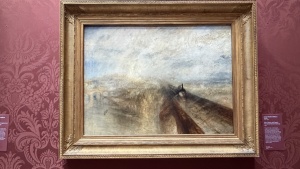
Turner’s Rain, Steam, and Speed – The Great Western Railway offers a very different experience.
The locomotive pushes towards us through rain, steam and atmospheric haze, while the railway bridge draws the eye deep into the landscape. Yet Turner also included much smaller elements: a boat on the river and, near the right edge, a man driving a horse-drawn plough.
He also painted a hare running along the track ahead of the locomotive. The detail has become effectively invisible as the paint has grown transparent with age, but historical evidence confirms its presence. Turner used these elements to set mechanised speed against slower forms of human, animal and natural movement.
The details matter not because they are hidden rewards for an observant viewer, but because they change the relationships within the painting. Speed is no longer represented only by the train. Different forms of movement, labour and technology begin to occupy the same image.
A detail can change how the whole is read.
Looking Before Reading
Museum labels are valuable. They can tell us who made an artwork, when and where it was made, what is known about its subject and what research has revealed about its history.
But there can be something to gain from delaying the label for a moment.
Look first. Notice something. Form a question.
Then read — and look again.
The second encounter may be different because information can direct attention towards something previously overlooked. The aim is not to choose between looking and knowledge, but to allow them to work together.
Attention Before Explanation
Spending longer with a painting does not guarantee that it will become easier to understand. Nor does every artwork require the same kind or duration of attention.
Sometimes sustained looking produces clarity. Sometimes it produces uncertainty. A relationship becomes visible, a detail complicates the first impression, or a question appears that was not there before.
That may be precisely the value of looking slowly.
A painting does not always need to become easier to explain. Sometimes closer attention simply allows us to see more clearly what there is to think about.